
Updated October 2026. Professional web design services should do more than make a website look polished. A serious engagement should connect business goals, user experience, content structure, responsive design, accessibility, performance, SEO foundations, analytics and post-launch maintainability.
That breadth is why two “web design” quotes can look similar on the surface but produce very different outcomes. One may include only visual layouts and basic page assembly; another may include research, information architecture, conversion planning, development, testing, analytics, training and support.
This guide is designed for business owners comparing providers. It explains what professional web design services should include, what may be excluded, how design differs from development, what drives cost, how to evaluate proposals, and which questions to ask before signing a contract.

What Are Professional Web Design Services?
Professional web design services cover the planning and creation of a website’s visual and user-experience layer, usually together with enough development work to turn that design into a functional website.
Depending on the provider and scope, the engagement may include:
- Discovery and strategy — business goals, audience, competitors, content and conversion priorities.
- Information architecture — deciding page hierarchy, navigation and user flows.
- UX design — structuring journeys so visitors can understand the offer and complete key actions.
- UI design — typography, colour, spacing, visual hierarchy, components and brand expression.
- Responsive design — layouts that adapt intelligently across mobile, tablet and desktop.
- Development — converting approved designs into a working website or CMS.
- Content implementation — adding supplied text, images, products, forms and other content.
- SEO foundations — crawlable architecture, metadata controls, headings, internal linking and indexation basics.
- Performance work — image handling, code efficiency, caching and Core Web Vitals considerations.
- Accessibility — keyboard usability, contrast, labels, meaningful alt text and semantic structure.
- Analytics and tracking — measurement setup for traffic and key actions.
- Testing and QA — browser, device, form, navigation and functional testing.
- Launch and support — deployment, handover, training, fixes and maintenance arrangements.
The important point is that the phrase “web design services” is broad. Always compare the actual deliverables rather than assuming every provider includes the same work.
Web Design vs Web Development: What Is the Difference?
Web design and web development overlap, but they are not identical.
| Web design | Web development |
|---|---|
| User journeys and page structure | Functional implementation |
| Wireframes and prototypes | Front-end code or CMS build |
| Visual hierarchy and branding | Back-end features and integrations |
| Typography, colour and components | Database, APIs, forms and ecommerce logic |
| Responsive layout decisions | Responsive behaviour in the browser |
| Interaction and usability decisions | Performance, security and deployment |
Many small-business projects combine both disciplines under one engagement. For more complex work, they may be separate specialist roles. When reviewing a proposal, ask whether the quoted price covers design only or a complete designed-and-built website.
What Should Professional Web Design Services Include?
Current guides that rank for this topic consistently focus on scope clarity: strategy, design, responsive implementation, SEO foundations, performance, analytics and post-launch support. The strongest buyer guides also explain exclusions and ownership rather than treating “professional” as a self-explanatory label.
1. Discovery and Business Goals
A provider should understand what the website is supposed to achieve before designing pages. Goals might include lead generation, online sales, appointment bookings, product discovery, recruitment, authority building or local enquiries.
Useful discovery questions include:
- Who are the priority customers?
- Which services or products matter most?
- What should a visitor do after landing?
- Which pages are commercially important?
- Which competitors or references are relevant?
- Who will maintain the website after launch?
2. Information Architecture and Navigation
A visually attractive website can still fail if visitors cannot understand where to go. The project should define the page hierarchy, navigation, important user paths and relationship between service, category, location, resource and conversion pages.
Good architecture also helps search engines understand the website and reduces future SEO restructuring.
3. UX and UI Design
UX focuses on whether the website is understandable and easy to use. UI focuses on how the interface communicates visually.
For projects that require deeper interface work, Vylino separates this capability into dedicated UI/UX design services.
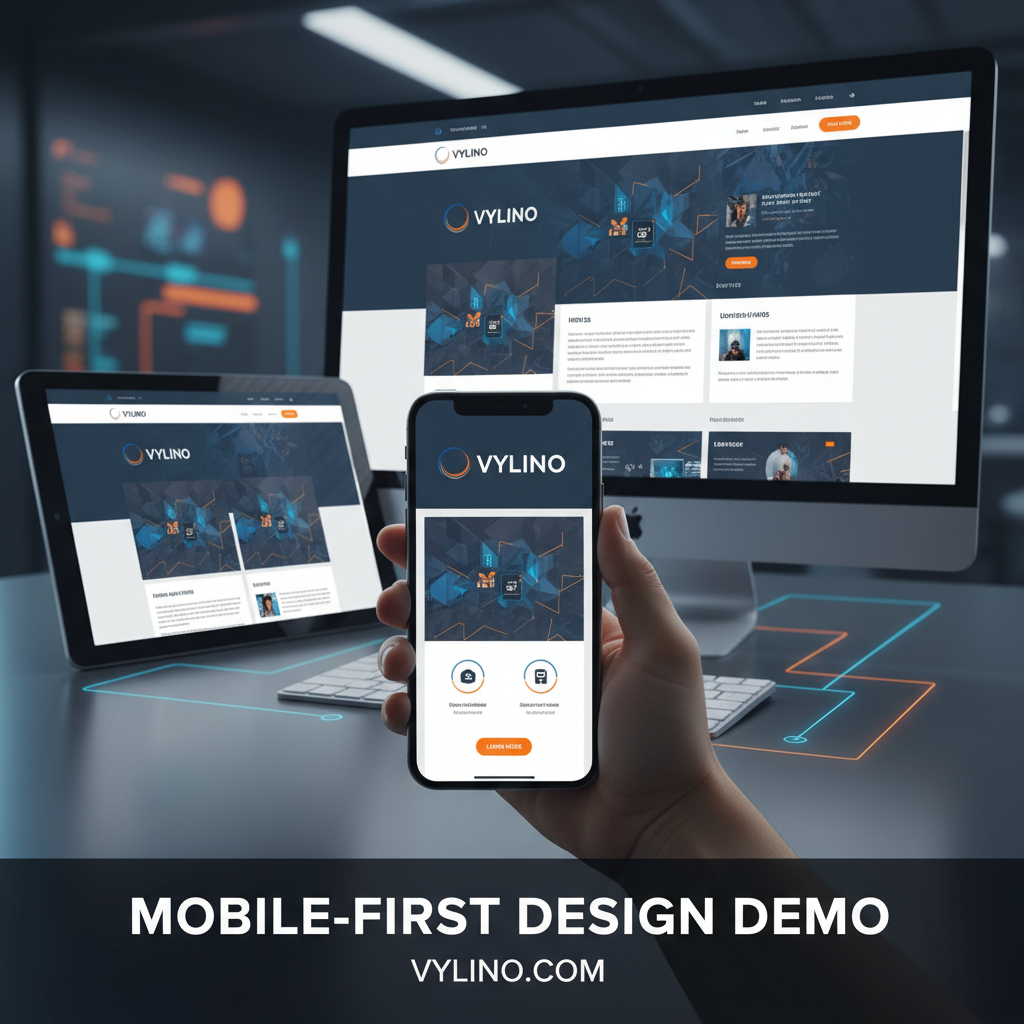
4. Responsive and Mobile Design
Responsive design should not mean simply shrinking a desktop layout. Navigation, content order, buttons, forms, tables, images and interactive elements should be designed for smaller screens intentionally.
The next article in this series covers this topic in more depth: responsive web design company benefits.
5. Accessibility
Accessibility should be considered during design, not added only after launch. Common requirements include readable contrast, logical heading structure, keyboard access, visible focus states, descriptive labels, form error handling, alt text and controls that do not rely only on colour.
The Web Content Accessibility Guidelines (WCAG) remain the main international reference for accessible web content. See the W3C WCAG overview.
6. Performance and Core Web Vitals
Design decisions affect loading performance. Oversized hero media, excessive animations, unoptimised fonts and heavy third-party scripts can make an otherwise attractive site slow.
Professional delivery should consider image sizing, lazy loading, caching, script usage and layout stability. Google’s Core Web Vitals guidance explains the current user-experience metrics used to assess loading, responsiveness and visual stability.
7. SEO Foundations
Web design is not the same as a complete SEO campaign, but the build should avoid creating unnecessary search problems. At minimum, confirm that the website supports editable titles and descriptions, logical headings, crawlable links, canonical controls, XML sitemaps, image alt text and indexation management.
A beautiful website with weak architecture or blocked pages creates extra work later.
8. Analytics and Conversion Tracking
If the website exists to generate enquiries or sales, the team should define what success means and make those actions measurable. Depending on the project, that may include contact-form submissions, calls, WhatsApp clicks, bookings, checkouts or downloads.
9. Testing and Launch
Before launch, the project should be checked across representative browsers and screen sizes. Forms, navigation, links, ecommerce flows, tracking, redirects, metadata and key interactive components should be tested.
10. Handover and Support
Clarify who owns the website, which accounts belong to the client, what licences renew, how backups work, who handles updates and how long post-launch support lasts.
Ownership and support are often more important than small differences in headline price.
What Is Commonly Not Included?
This varies by provider, but businesses should never assume the following are included unless the proposal says so:
- Copywriting for every page.
- Logo or full brand identity design.
- Professional photography or video production.
- Paid stock imagery or premium font licences.
- Advanced SEO campaigns or link building.
- Large-scale product uploads or data migration.
- Custom CRM, ERP or API integration.
- Ongoing hosting, domain renewal or email.
- Unlimited revisions.
- Ongoing maintenance after the support period.
- Advertising campaign setup.
- Legal or compliance review.
Clear exclusions reduce disputes and make competing quotes easier to compare.
Types of Professional Web Design Services
| Type | Best suited to | Main consideration |
|---|---|---|
| Template-led business website | Small businesses with standard requirements | Efficiency and budget, but confirm how much customisation is included |
| Custom UI/UX website | Brands needing differentiated journeys or interface design | Requires more discovery, design and QA |
| WordPress website | Content-heavy and service businesses needing easy management | Theme/plugin architecture and maintainability matter |
| Ecommerce website | Businesses selling products online | Catalogues, checkout, payments, shipping, tax and conversion flows |
| Landing page | Focused campaigns or one-off offers | Message-to-action alignment and tracking |
| Website redesign | Existing websites with UX, branding or performance problems | Migration, redirects and preserving existing SEO signals |
Vylino has separate commercial pages for ecommerce website development, landing page design and website redesign services, so this article remains the comparison and buying guide rather than competing with those service pages.
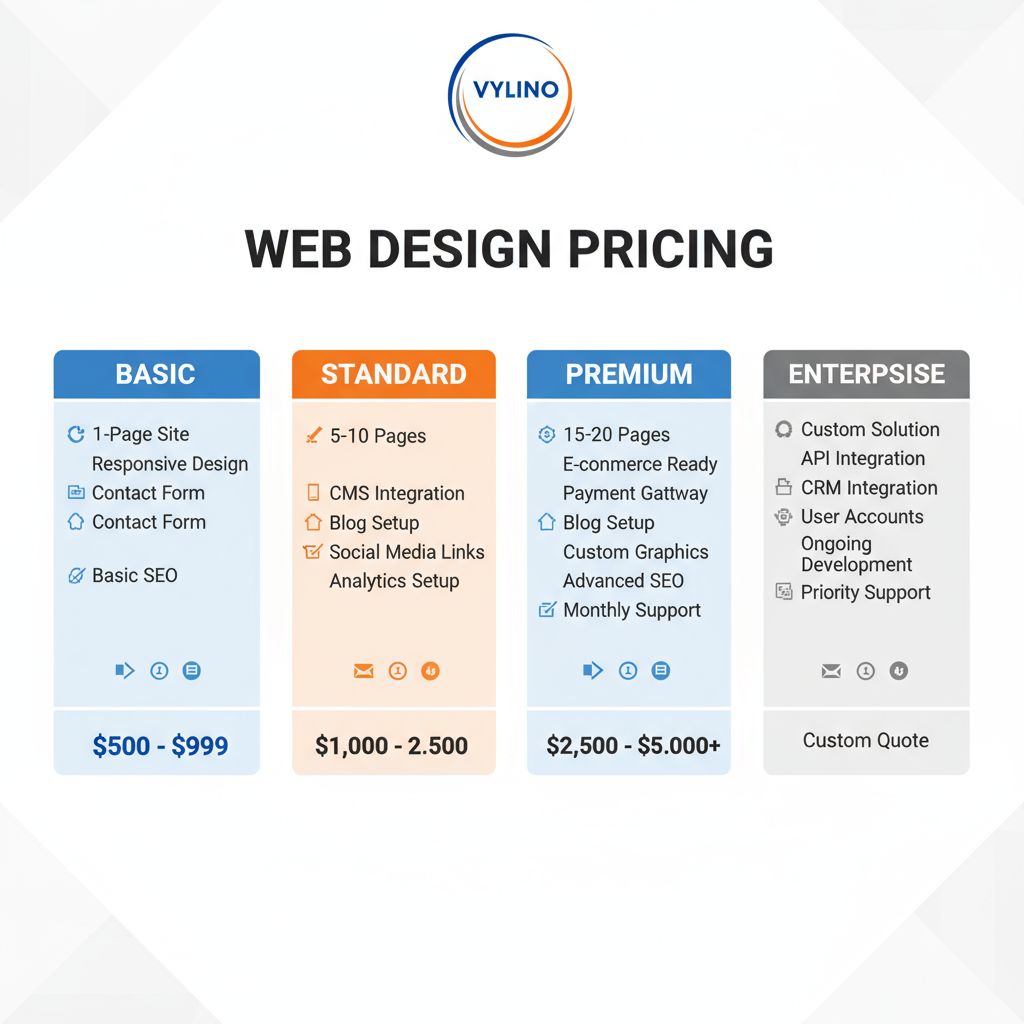
How Much Do Professional Web Design Services Cost?
There is no reliable universal price because “web design” can describe anything from customising a small template to designing and developing a complex ecommerce or enterprise platform.
Cost is usually driven by:
- Number of unique page templates.
- Custom UI/UX depth.
- Content and copywriting requirements.
- CMS or platform choice.
- Ecommerce functionality.
- Forms, bookings, memberships or portals.
- Third-party integrations.
- Migration from an existing site.
- Performance and accessibility requirements.
- Testing, training and support.
Rather than repeating broad market-price claims here, Vylino maintains a dedicated website development cost in India guide for businesses that specifically want budgeting ranges and price drivers.
Template vs Custom Web Design
Neither approach is automatically better. The right choice depends on how different the business needs to be and how much functionality or experience is unique.
| Template-led | Custom design |
|---|---|
| Faster to launch | More tailored to the brand and user journey |
| Lower design cost | Higher design and QA effort |
| Good for common business layouts | Better for complex or differentiated interfaces |
| May inherit theme limitations | Can be designed around exact requirements |
| Quality depends heavily on customisation | Quality depends heavily on research and execution |
A well-customised template can be better than a poorly researched “custom” design. Judge the outcome and process, not only the label.
How to Compare Web Design Proposals
Compare proposals line by line instead of comparing only the total amount.
| Check | Questions to ask |
|---|---|
| Scope | How many unique pages/templates are included? Which functions? |
| Design | Template-led, custom UI, or both? Are wireframes included? |
| Content | Who writes, edits and uploads text/images? |
| SEO | Which technical/on-page foundations are included? |
| Performance | What optimisation work is included before launch? |
| Ownership | Who owns the domain, hosting, website files, accounts and licences? |
| Revisions | How many rounds and at which stages? |
| Testing | Which browsers, devices and functions are tested? |
| Support | What happens after launch and for how long? |
| Recurring costs | Hosting, licences, maintenance, apps, email or support? |
For a more detailed comparison framework, use Vylino’s website quote comparison checklist.
How to Choose a Professional Web Design Company
Review Live Work, Not Only Screenshots
Open recent websites on mobile and desktop. Check navigation, clarity, loading behaviour, forms and readability. A portfolio image cannot show performance, maintainability or conversion flow.
Ask Who Actually Does the Work
Understand whether the project is completed by an in-house team, specialist contractors or another agency. Outsourcing is not automatically a problem, but the delivery model should be transparent.
Ask About Ownership Before Signing
Confirm control of the domain, hosting account, CMS administrator access, analytics, Search Console, premium licences, source files and any third-party integrations.
Check Whether the Process Is Defined
A professional process should explain discovery, approvals, revision stages, content responsibilities, testing and launch. Vague processes often create scope disputes later.
Check Post-Launch Responsibilities
Ask who handles plugin/platform updates, backups, security monitoring, content edits and bug fixes after the initial support period.
Red Flags When Hiring Web Design Services
- “Unlimited everything” with no written scope.
- No clarification of ownership or administrator access.
- A portfolio made only of mockups rather than live websites.
- No mobile or browser testing process.
- Guaranteed SEO rankings included as a design promise.
- No explanation of recurring licences or hosting costs.
- No backup or recovery plan.
- Every business receives the same structure regardless of goals.
- Design begins before basic requirements and content are understood.
- The provider cannot explain what happens after launch.
What Should You Prepare Before Hiring a Web Designer?
Projects move faster when the client prepares the basics early:
- Business goals and primary conversion action.
- Priority services/products.
- Target customers and geographic markets.
- Brand files and style references.
- Required pages and features.
- Existing website, domain and hosting access if applicable.
- Examples of websites you like and why.
- Available copy, images, testimonials and case studies.
- Required integrations.
- Launch deadline and approval stakeholders.
A clear project brief can prevent major misunderstandings before design starts.
Professional Web Design for Small Businesses
Small businesses do not necessarily need expensive custom interface systems. They usually need a website that communicates the offer clearly, works well on mobile, loads reliably, is easy to update and gives visitors obvious next steps.
A sensible small-business scope may prioritise:
- Home, about, service and contact pages.
- Clear service-area or location information.
- Calls, WhatsApp, enquiry forms or booking actions.
- Trust signals such as reviews, certifications or case studies.
- Basic analytics and Search Console setup.
- Editable CMS access.
- SEO-ready page structure.
- Simple ongoing maintenance.
The objective is not to buy every possible feature. It is to build the right foundation and add complexity when the business case exists.
How Long Does Professional Web Design Take?
Timelines vary with scope, content readiness, approvals and integrations. The largest delays are often not caused by coding—they come from missing content, unclear feedback, changing requirements or third-party dependencies.
Vylino maintains a separate website development timeline guide for planning discovery, design, development, QA and launch stages.
Frequently Asked Questions
What do professional web design services include?
They commonly include discovery, information architecture, UX/UI design, responsive layouts, development or CMS implementation, content setup, SEO foundations, performance work, testing, analytics and post-launch support. Exact scope varies, so always check the proposal.
Is web design the same as web development?
No. Design focuses primarily on structure, user experience and visual interface; development turns that design into functional code or a CMS implementation. Many agencies sell both together.
Should SEO be included in web design?
Basic SEO foundations should be considered during the build, but a complete SEO campaign is usually a separate service. Confirm exactly what is included instead of assuming “SEO-friendly” covers ongoing keyword research, content strategy or link acquisition.
Do I need custom web design?
Not always. A template-led build can be appropriate for a standard small-business site. Custom design is more useful when the brand, conversion flow, interface or functionality cannot be handled well with an existing structure.
What should I own after the website is finished?
At minimum, clarify ownership and control of the domain, hosting, CMS administrator account, analytics/search accounts, website content and any licences or assets purchased specifically for the project.
How do I compare two web design quotes?
Compare scope, page templates, design method, content responsibilities, integrations, SEO/performance work, ownership, revisions, testing, support and recurring costs. A lower price is not necessarily cheaper if important deliverables are excluded.
Final Takeaway
Professional web design services should be judged by the clarity of the scope and the quality of the outcome—not by how many features are listed or how fashionable the design looks.
Before hiring a provider, define the business objective, compare deliverables carefully, confirm ownership and recurring costs, ask how performance and accessibility are handled, and make sure the post-launch responsibilities are written down.
If you want Vylino to help assess an existing site before deciding whether you need redesign, development or optimisation, start with a website audit.