
Updated October 2026. SEO reporting is useful only when it connects search visibility to business outcomes. Rankings, impressions and organic traffic can show whether visibility is changing, but they do not automatically tell you whether SEO is generating qualified leads, revenue or useful customer actions.
This guide explains how to build a practical SEO reporting system using Google Search Console, Google Analytics 4 and business conversion data; which SEO KPIs matter; how to calculate SEO ROI; and where attribution can become misleading.
If you need implementation rather than a reporting framework, see Vylino SEO services. If the underlying performance problem is unclear, start with a professional SEO audit.
What Should an SEO Report Actually Answer?
A useful report should help a business answer five questions:
- Are we becoming more visible for relevant searches?
- Which pages and queries are gaining or losing performance?
- Is organic search producing meaningful visits and actions?
- Which SEO work appears to be contributing to those changes?
- What should we do next?
If a report cannot help make a decision, it is probably too focused on vanity metrics.
Core SEO Reporting Metrics
1. Impressions
Google Search Console counts an impression when a result from your site is shown in Google Search under its reporting rules. Impressions help show whether Google is surfacing your pages more often for relevant searches. See Google’s official definitions of impressions, clicks and position.
Impressions are useful for detecting early visibility growth, especially before clicks increase, but they should be interpreted alongside query relevance and average position.
2. Clicks
Clicks show how often searchers clicked through from Google Search to your site. A page can gain impressions without gaining clicks, so both metrics should be reviewed together.
3. Click-through rate (CTR)
CTR is calculated as:
CTR = Clicks ÷ Impressions × 100
A low CTR can have several explanations: weak title/snippet relevance, low ranking position, broad informational impressions, search features that satisfy users without a click, or competition from stronger-looking results.
4. Average position
Search Console’s average position is based on the position of the topmost result from your site for the relevant aggregation. Google explicitly distinguishes site-level and page/query-level aggregation, so this metric is best used for directional trend analysis rather than treated as a fixed daily rank. Queries, locations, devices and result layouts also vary.
5. Organic landing-page sessions
Google Analytics 4 can show how users arriving from organic search behave after they reach the site. This helps connect search visibility with engagement and conversion activity.
6. Key events and conversions
In GA4, an event that measures an action important to the business can be marked as a key event. Examples may include form submissions, calls, bookings, account sign-ups, quote requests or purchases.
Google now uses conversion more specifically for an important action used for advertising measurement and optimization, typically created from a GA4 key event. The practical sequence is Event → Key event → Conversion when the same action also needs advertising measurement. See Google’s key events vs conversions guidance.
For an SEO report, key events are usually the right behavioral layer; business systems such as CRM or ecommerce data should then determine whether those actions became qualified leads, customers or revenue.
7. Revenue or lead value
Ecommerce businesses can use transaction revenue. Lead-generation businesses may assign an estimated value to qualified leads if the organization has reliable close-rate and average-value data.
Do not assign arbitrary values simply to make ROI look stronger. The assumptions should be documented and reviewed.
SEO KPIs: Which Metrics Matter Most?
There is no universal SEO KPI list. The correct KPIs depend on the site’s business model.
| Business type | Useful primary KPIs | Useful supporting metrics |
|---|---|---|
| Local service business | Qualified calls, forms, bookings | Local service query clicks, landing-page CTR, branded vs non-branded visibility |
| B2B service company | Qualified enquiries, pipeline value | Commercial landing-page clicks, target-query visibility, assisted conversions |
| Ecommerce | Organic revenue, transactions, conversion rate | Category/product clicks, non-brand traffic, revenue per landing page |
| Publisher / content site | Qualified organic audience, subscriptions or ad value | Topic growth, returning users, engagement, indexed content performance |
| SaaS / product | Trials, demos, sign-ups, pipeline | Feature/use-case query growth, product-page conversions, branded discovery |
How to Measure SEO ROI
A common SEO ROI formula is:
SEO ROI = (SEO-attributed value − SEO cost) ÷ SEO cost × 100
For ecommerce and businesses with known margins, gross profit or contribution value is often a better numerator than top-line revenue because revenue can make ROI look stronger than the economics really are.
Example:
- Estimated gross profit attributed to organic search: ₹3,00,000
- SEO investment: ₹1,00,000 (strategy, content, technical work, tools and other included SEO costs)
- SEO ROI: (₹3,00,000 − ₹1,00,000) ÷ ₹1,00,000 × 100 = 200%
The arithmetic is simple. The difficult part is deciding what “SEO-attributed value” really means and how much credit organic search should receive. For planning the cost side of the equation, see Vylino’s SEO cost in India guide.
Why SEO Attribution Is Not Perfect
A user may first discover a business through organic search, return later through a direct visit, then convert after seeing a remarketing ad or receiving an email. Different attribution models can assign credit differently.
GA4 currently supports data-driven attribution and last-click variants for key-event reporting. Google’s data-driven model distributes credit using property-specific path data, while last-click models assign credit according to the final eligible interaction. See Google’s attribution overview.
Attribution is not the same as incrementality. An attribution report describes how credit is assigned within observed journeys; it does not prove that the conversion would not have happened without SEO. Treat attributed value as a measurement model, not experimental proof of causation.
That means an SEO report should avoid claiming that every organic-assisted sale was caused only by SEO.
Useful attribution practices include:
- Separating direct organic conversions from assisted influence.
- Tracking first-touch and later-touch behavior where available.
- Using CRM lead-source data for qualified leads and closed sales.
- Comparing branded and non-branded organic acquisition.
- Documenting assumptions used to calculate lead value.
- Reviewing longer periods for SEO because results often compound gradually.
Search Console Metrics vs GA4 Metrics
Search Console and Google Analytics measure different parts of the journey.
| Search Console | Google Analytics 4 |
|---|---|
| Search impressions | Website sessions/users |
| Google Search clicks | On-site engagement |
| CTR | Key events |
| Average position | Conversions and revenue reporting |
| Query-level search data | Cross-channel website behavior |
Search Console explains what happened before and at the click from Google Search. GA4 helps explain what happened after the user reached the website. A strong SEO report uses both rather than expecting either platform to answer every question.
Important Search Console Data Limitations
Search Console is extremely useful, but its query tables are not a complete ledger of every search.
- Some low-volume queries are anonymized for privacy.
- The interface can omit rows because Search Console stores and shows the most important rows rather than every query.
- Chart totals can therefore be higher than the sum of visible query rows.
- Performance data is normally published with a delay, and recent data can be preliminary.
- Search Console and GA4 can differ because they use different collection methods, processing and time zones.
Google documents these limitations in About Search Console data and its Performance report discrepancy guidance.
This matters when reporting branded vs non-branded search, long-tail queries or exact query totals: visible rows should not be treated as 100% of all search demand.
How to Build a Monthly SEO Report
Section 1: Executive summary
Start with the business impact, not a table of 200 keywords.
Summarize:
- What improved.
- What declined.
- What changed materially.
- What appears to have caused the change.
- What action is recommended next.
Section 2: Search visibility
Review:
- Clicks.
- Impressions.
- CTR.
- Average position.
- Important query clusters.
- Important landing pages.
Section 3: Organic conversions
Report the actions that matter to the business:
- Forms.
- Calls.
- Bookings.
- Purchases.
- Qualified leads.
- Revenue where reliable.
Section 4: Work completed
Explain what SEO work actually happened, such as:
- Technical fixes.
- Content refreshes.
- New pages.
- Internal-link improvements.
- Structured-data fixes.
- Local SEO work.
- Authority or outreach work.
Section 5: Next priorities
A useful report should end with a prioritized action list, not just observations.
How to Compare SEO Performance Over Time
Month-over-month comparison is useful, but it can be misleading when seasonality or campaigns affect demand.
Better comparisons may include:
- Month over month for fast-moving changes.
- Quarter over quarter for larger strategic trends.
- Year over year for seasonal businesses.
- Pre-change vs post-change after a major migration or redesign.
- Page cluster vs page cluster for content-program analysis.
Always compare equivalent date ranges where possible.
Branded vs Non-Branded SEO Reporting
A growing business may receive more organic traffic simply because more people are searching its brand name. That is useful, but it is different from gaining visibility for non-branded commercial queries.
Search Console now includes a branded/non-branded query filter for eligible properties. Google notes that the filter is informational, can misclassify some queries and is not available for sites with very low impression volume. It provides up to 16 months of history from its March 2025 introduction. See Google’s query-dimension documentation.
Separate:
- Branded search: company name, product name, founder name, branded variations.
- Non-branded search: service, problem, location and comparison queries that do not depend on prior brand awareness.
This distinction makes SEO growth easier to interpret.
Page-Level SEO Reporting
Sitewide totals can hide important problems. Review performance by page type:
- Core service pages.
- Location pages.
- Product/category pages.
- Blog/resources.
- Conversion landing pages.
For each page, ask:
- Which queries trigger impressions?
- Is the page ranking for the intended intent?
- Is CTR improving or declining?
- Are visitors taking the desired action?
- Does the page need stronger content, internal links or technical fixes?
SEO Reporting for Content Refreshes
When old content is updated, do not judge the result only by whether average position improves immediately.
Track:
- New query coverage.
- Changes in impressions.
- Changes in clicks and CTR.
- Movement in relevant keyword clusters.
- Organic conversions from the page.
- Internal-link contribution to related pages.
This is especially important when the refreshed page supports a commercial service page rather than converting directly.
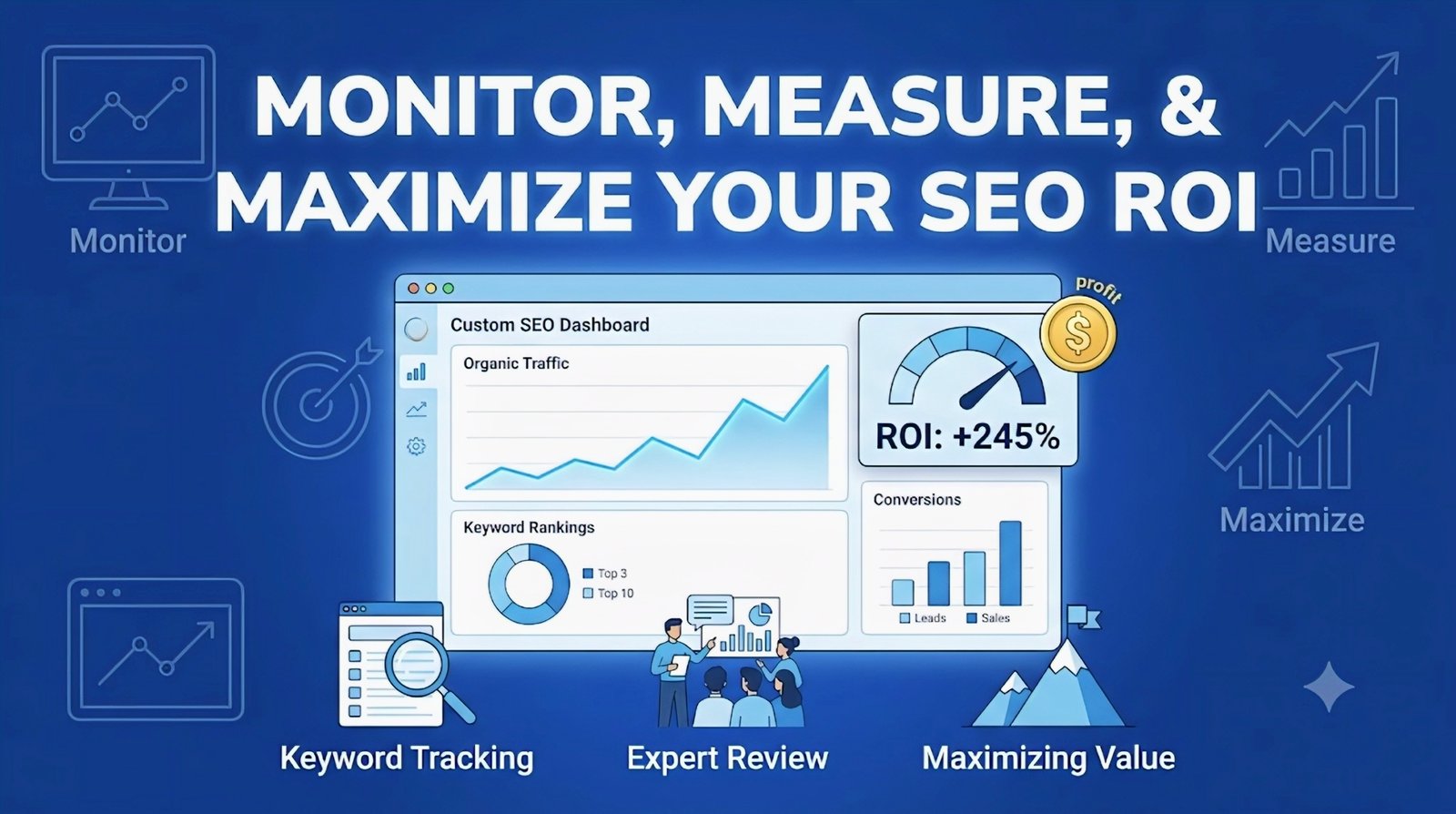
SEO Dashboard: What Should It Show?
A dashboard should make recurring monitoring easier, not replace interpretation.
A practical dashboard may contain:
- Organic clicks and impressions.
- Top landing pages.
- Top non-branded queries.
- CTR trends.
- Organic sessions.
- Key events.
- Revenue or lead value.
- Technical/indexing issues requiring attention.
A dashboard with fifty charts is not automatically better than one with eight useful charts.
Common SEO Reporting Mistakes
Reporting only rankings
Rankings are useful context, but they do not show whether the traffic converts.
Reporting traffic without intent
Large increases from irrelevant informational queries can look impressive while producing no commercial value.
Using “Domain Authority” as a Google KPI
Third-party authority metrics can help with comparative analysis, but they are not Google ranking scores and should not be presented as direct Google performance metrics.
Claiming exact attribution
Organic search often influences multi-touch journeys. Avoid presenting uncertain attribution as precise fact.
Ignoring implementation
A report should identify which changes were made. Otherwise it becomes difficult to connect actions with outcomes.
Ignoring seasonality
Traffic can rise or fall because search demand changes, not because SEO suddenly improved or failed.
SEO ROI for Lead-Generation Businesses
Lead-generation businesses often need to connect GA4 or form data with CRM outcomes.
A stronger model is:
- Track organic lead submissions.
- Identify qualified leads in the CRM.
- Track closed customers.
- Calculate average revenue or gross profit per customer.
- Estimate organic-search contribution with clearly documented attribution rules.
Using raw form submissions alone can overstate results if many leads are low quality.
SEO ROI for Ecommerce
Ecommerce measurement is usually more direct because purchase revenue can be captured, but additional care is still needed.
Review:
- Organic revenue.
- Transactions.
- Conversion rate.
- Average order value.
- New vs returning customer behavior.
- Category and product landing-page performance.
- Branded vs non-branded acquisition.
What a Good SEO Agency Report Should Include
If you are paying for ongoing SEO, the report should make the work auditable.
Look for:
- Baseline and comparison period.
- Search Console performance.
- Conversion data.
- Important page/query changes.
- Completed work.
- Technical issues.
- Content changes.
- Clear next actions.
- Explanation of assumptions and limitations.
Be cautious of reports that contain many screenshots but do not explain what changed or what should happen next.
How Vylino Approaches SEO Reporting
Vylino’s reporting approach is built around the business objective first. A local service company, ecommerce store and B2B website should not receive identical KPI dashboards.
Where data access is available, reporting can combine Search Console, GA4 and conversion information to review:
- Relevant search visibility.
- Priority landing pages.
- Query intent.
- Organic key events.
- Technical issues.
- Content performance.
- Next-page and internal-link opportunities.
For keyword mapping and search-demand research, see SEO keyword research. For a broader growth framework, read the small business SEO strategy.
Frequently Asked Questions
What is SEO ROI?
SEO ROI compares the estimated value generated by organic-search activity with the cost of SEO. The calculation is straightforward, but attribution and lead/revenue valuation should be documented carefully.
What are the most important SEO KPIs?
For most businesses, important KPIs include organic conversions or revenue, relevant search clicks, landing-page performance and non-branded visibility. Rankings, impressions and CTR are valuable supporting metrics.
How often should SEO reports be reviewed?
Monthly reporting is common for ongoing SEO because it balances recency with enough data to interpret trends. Fast-moving technical incidents may need more frequent monitoring, while strategic performance is often clearer over quarterly or year-over-year comparisons.
Is traffic enough to prove SEO success?
No. Traffic can rise from low-value or irrelevant queries. Reporting should connect traffic with intent and meaningful business actions.
Can Google Search Console measure revenue?
No. Search Console reports search visibility and clicks. Revenue, key events and on-site behavior are measured through analytics, ecommerce systems, CRM data or other business systems.
What is the difference between a key event and a conversion in GA4?
Google Analytics now uses “key event” for an important user action in Analytics. A conversion refers to an important action used for Google Ads measurement and optimization when created from a key event.
Should SEO reports include Domain Authority?
Third-party authority metrics can be included as supporting competitive indicators, but they should not be presented as Google metrics or direct ranking factors.
Measure SEO as a Business System
The purpose of SEO reporting is not to prove that every metric went up. It is to make performance understandable, separate signal from noise, and guide the next decision.
Track search visibility, user behavior and business outcomes together. Document attribution assumptions. Compare equivalent periods. Then use the report to decide which pages, technical issues or content opportunities deserve the next investment.
If you want help building an SEO measurement framework around your website, contact Vylino.